
La la land sparing
Vertical farms' ability to spare land is context-dependent

Land sparing is one of the many purported benefits of vertical farming.
It is the idea of producing a given quantity of food on as little land as possible by achieving high productivity (kg food per m2), and then “sparing” remaining land for natural habitats, protected areas, or restoration. That way, the spared land can turn into carbon sinks and help alleviate climate change while still feeding the population (1, 2).
Although the effectiveness of land sparing is debated (2), what is the potential of CEA to spare land?
Can CEA actually spare land? If yes, in what circumstances?
That vertical farms (VFs) can spare land was proposed by Dr Despommier in his papers:
“Farming indoors creates the opportunity of returning land back to nature, allowing it to resume its multiple ecological functions, many of which are directly beneficial for us.” (2011).
“Hence, in my opinion, the widespread application of CEA within urban centers could eventually have a significant positive effect on lowering the rate of climate change” (2013)
Indeed, VFs are a prime candidate for sparing land. By producing food 20-30 times more per unit area compared to field or greenhouses, VFs need 20-30 times less land to produce the same amount of food.
However, when looked at closely, this logic does not hold. The answer to “can CEA spare land?” goes from “yes/no” to “it depends”.
And, it depends on three factors.
1. Energy source
While VFs save land where the building sits (direct land use), running them requires massive amounts of energy. The land used to generate energy that powers these farms, which can vary based on the energy source, is also considered part of the total land use of VFs (indirect land use).
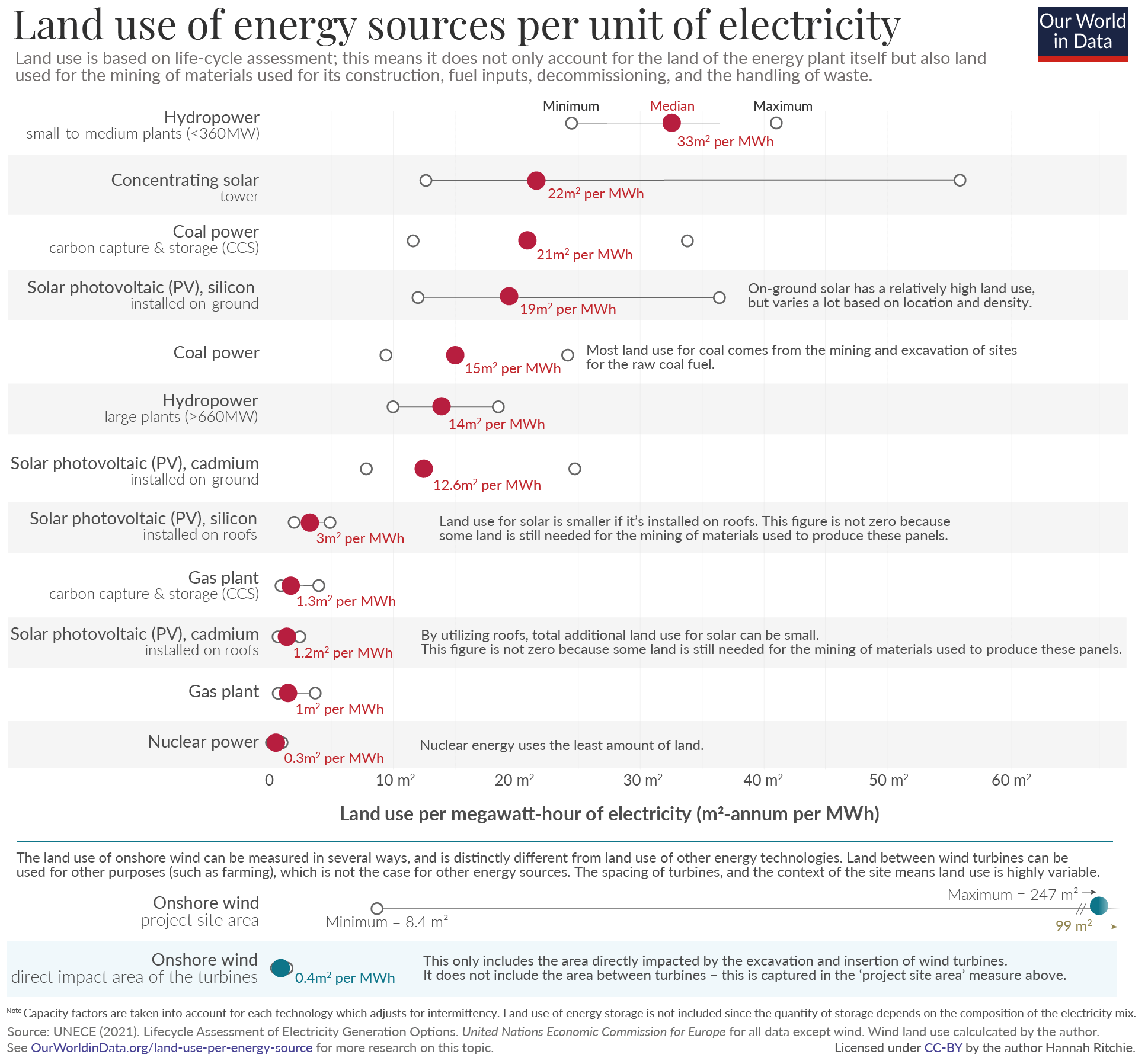
As such, life-cycle analyses show that the total land use (direct+indirect) of VFs varies with the energy sources (1, 2, 3) powering them. The location of the energy source also matters.
Weidner et al (2022) calculated the total land use and land sparing potential of vertical farms, open fields, and greenhouses for localised, low-carbon vegetable production across nine urban areas.
They found that, when accounting for the land used for energy generation (solar and wind), greenhouses are usually the most land-efficient, while VFs often failed to spare land compared to open fields. The source of energy also affected the total land use (figure below). Rather than relying on the existing energy grid, adding additional solar and wind generation capacity to run VFs that can deliver half of the vegetable intake of these cities can result in more land use per capita than open fields (in Stockholm, Tokyo, Chile, Johannesburg, Phoenix, Singapore, and the UAE).
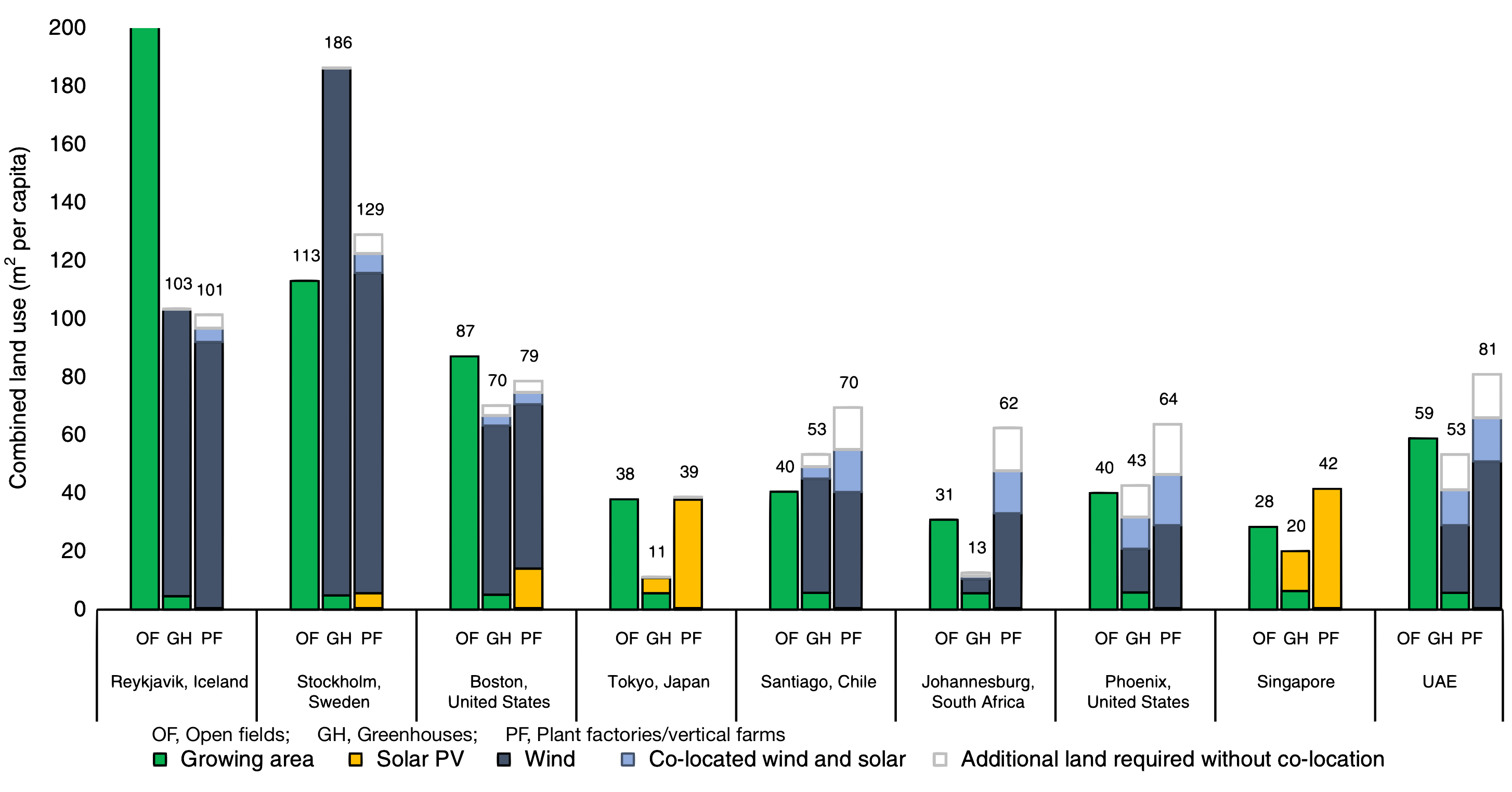
For a low-carbon net-zero future, towards which we are moving, VFs have to be powered by renewables like solar and wind. These energy sources are notoriously land-intensive themselves. However, there are locations with abundant availability of wind (Reykjavik) or sunlight (UAE), where the land use for a kWh of energy generated drops significantly, leading to land sparing opportunities with vertical farms.
Therefore, the energy source and the location currently preclude VFs from sparing land compared to open fields in most cases.
2. Crop grown
Crops also affect land spared through their energy consumption. Lettuce is highly energy-efficient, whereas longer-duration crops like tomato or wheat need more energy, resulting in a larger footprint.

Kobayashi et al (2022) compared the indirect land use for various crops as a function of their energy requirement. Though moving staple crops (potato and wheat) into VFs frees up larger areas of land due to their relatively low outdoor yields, the land spared is still insufficient to provide the energy required to grow them with renewable sources.
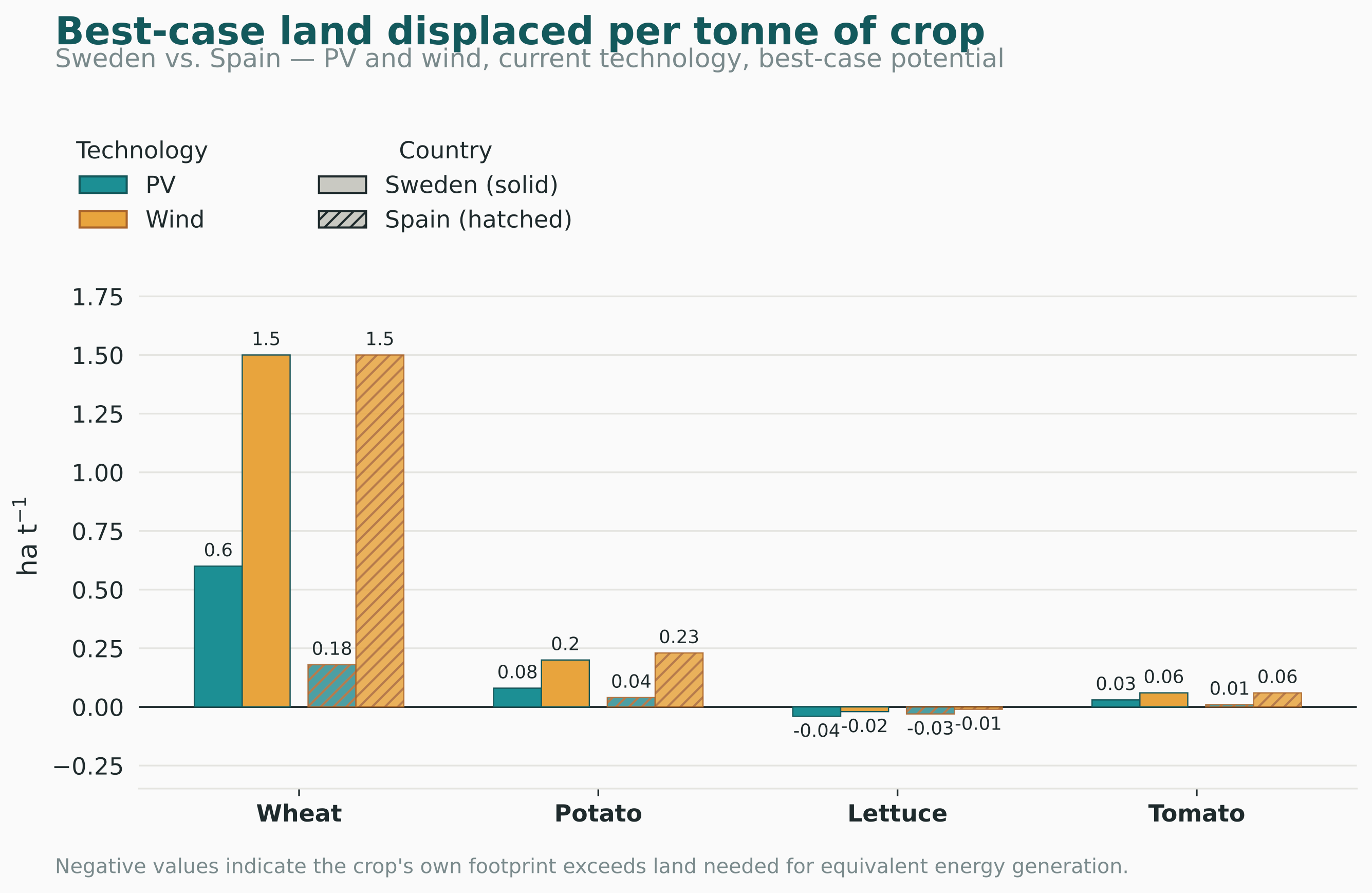
The effect of crop can also be looked at through the current global land use of crops. The most land-intensive crops are staple crops, including rice, wheat, maize, soybeans, etc.
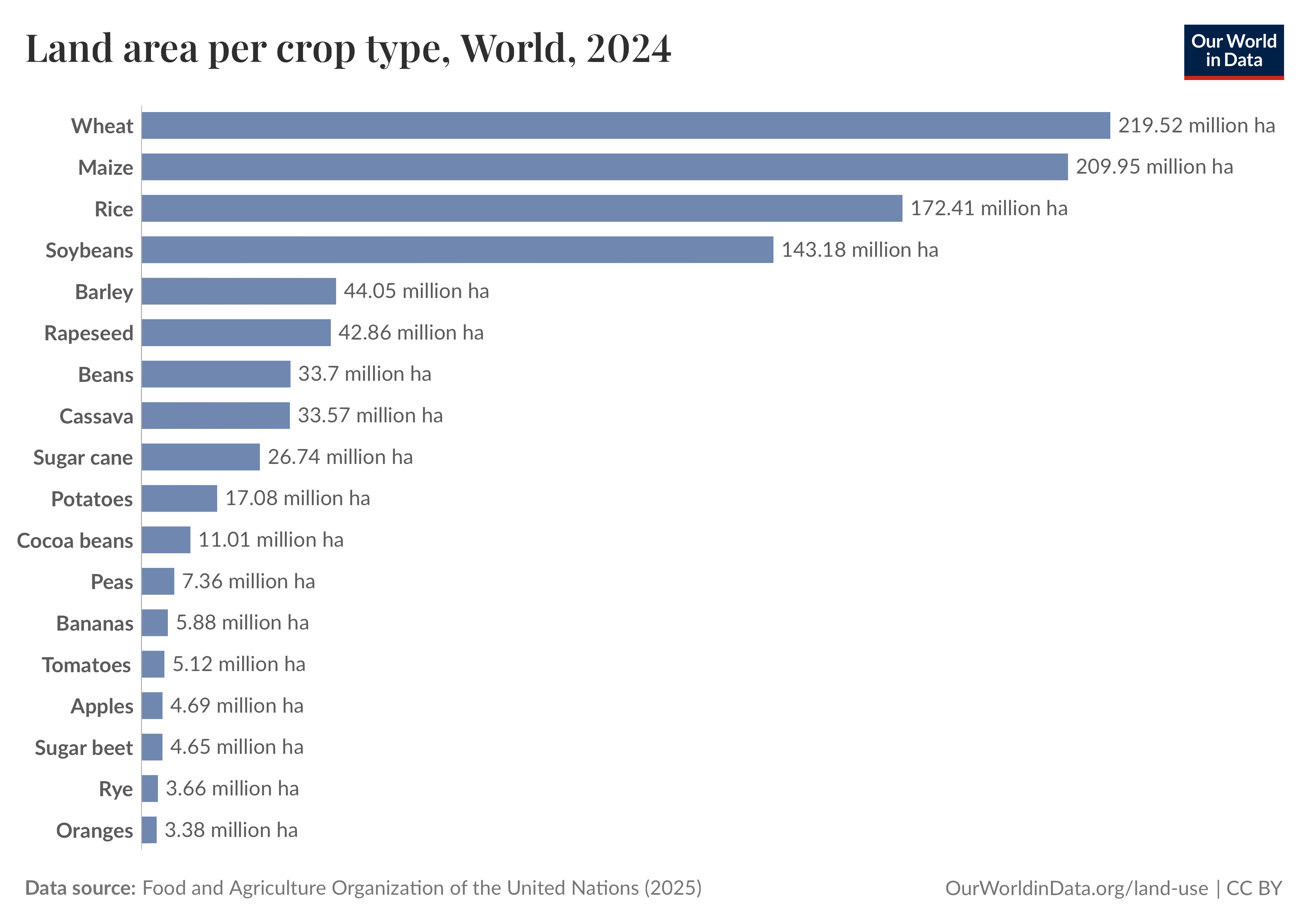
In contrast, crops currently grown in vertical farms (leafy greens, herbs, and some vegetables) cover less than 5% of the global agricultural land area. Unless VFs take on the production of these land-intensive staple crops, VFs have no sizeable contribution to land sparing.
3. Sparability of land
Finally, we have the most basic factor determining VFs land spring potential: land sparability.
Even if VF spared land, is the spared land useful for conservation efforts?
Many locations where CEA can improve food production have no sparable land that can be used for restoration due to harsh conditions. For instance, any land spared in the UAE is a barren desert that cannot give way to any conservation efforts.
Although VFs in the UAE can offload land required from where the produce would be imported otherwise, who is enforcing cross-border land sparing?
Put together, VFs’ ability to spare land depends on the energy source, crops grown, and the land use potential of the spared land. Using newly added renewable energy sources (PV and wind) can take over more land than can be spared; growing niche crops with an already small land footprint is insignificant to spare land; and VFs in harsh areas fall short in land sparing, as the land spared is not useful for conservation efforts.
Unless we grow staples at the right locations with energy from renewable sources that have low land use per kWh (or nuclear), VFs ain’t sparing any land.
I didn’t paywall this post because I want it to be accessible to everyone involved in vertical farming. If this changed how you think about something, consider subscribing. By subscribing, you’d be supporting my work and getting my upcoming posts.
Read More
The end of productivity gains in vertical farming

Vertical farms produce over 20-40 times more lettuce per m² than field production. They achieve this by providing plants an optimal environment: adequate lighting, tailored spectra, tight climate control, and precise fertigation systems. This has led to massive gains in productivity.